Wednesday, November 17, 2010

Coming Home to Roost

After posting about losing my camera a while back, a friend got in touch with me letting me know that there was an extra camera in his household that wasn't being used, and I could have it if I wanted to. Yes I did! I was thrilled.

And I had the camera with me on my way home from work yesterday and managed to catch a few shots of the crows heading to their roost.


Keep in mind, that this is just a couple of sections of the sky and one portion of the flock. It usually takes about a half hour for all the crows to fly overhead at any given point. This flock is coming from the north west. I've also seen them flying in from the east and the north. So that should give you an idea of the numbers of birds we're talking about here. I'm guessing it's about an 1/8 of the human population of Ottawa.

These crows will probably hang out in a few 'staging areas' near the roost, before they make their way to the actual roost to settle in for the night.

If I can I'll try and snap some pics of the roost soon.

Monday, November 15, 2010

Yes, another post about crows...

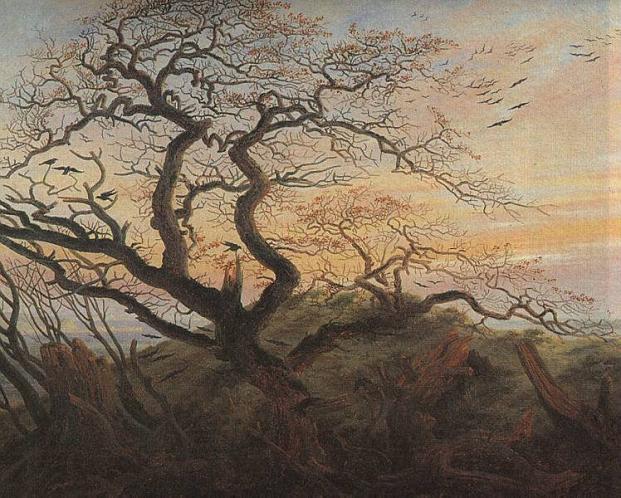
I don't quite know what it is about crows, but I'm becoming increasingly fascinated by them. From their twilight flights and massive roosts to their highly intelligent ways, the more I learn about crows the more I want to learn. I also find them very visually striking against the urban landscape, especially at this time of year when the tree branches are bare.

This video gives a really good idea of what the roost near my home is like at night.


And this one is really cool too.


And here are some examples of crow art that I'm enjoying very much.

Source


Source


Source

Finally, after watching this TedTalk, there'll be no doubt in your mind just how smart crows are!


Incidentally, I'm not super impressed with Joshua Klein's take on 'developing mutually beneficial relationships' with crows. Using crows to pick up our garbage or to find our lost iPhones sounds a little demeaning to me and I also thinks he hugely misses the point between the connection of large crow populations and the health of our ecosystems. Still it's a pretty neat look at crow behaviour.

We Walk Around Like Poems


Another lovely excerpt from Crow Planet:

"We are incapable of isolation. Every time we sip wine, feed the cat, order pizza, watch Survivor, every time we do anything, anything at all, we are brushing, however surreptitiously, however beneath our awareness- however, even, against our will- a wilder, natural world. Such awareness is simultaneously daunting and beautiful. It means that everything we do matters, and matters more than we can even know. Yes, of course we must do all of the things we now know by rote: we must replace our incandescent lightbulbs with compact fluorescents, and recycle, and compost and ride our bikes, and buy organic, local, biointensive, fair-trade. All of it. And if we can manage these things with a joyful heart, then all the better. But this is not about checklists, is it? About the reduction our planetary relationships to a mean tally of resources used, saved and available? It is about a habit of being, a way of knowing, a way of dwelling. It is about attentive recognition of our constant, inevitable continuity with life on earth, and the gorgeous knowledge this entails. There is a crow's nest in the neighbor's yard, and there are feathers at our feet. We walk around like poems- our lives infused with meaning beyond themselves."


I think about this passage a lot as I observe the crows in my neighbourhood. There is a roost close to my home that I've taken to visiting. Every night at dusk the crows fly overhead and easily 100,000 or more of them roost in a small patch of woods, to fly away again at dawn. It is both an incredible and disturbing sight. Disturbing because there is a connection between crow populations and habitat destruction and biodiversity loss. As the environment becomes less hospitable to other species, crows become one of the few species resilient enough to survive. Growing crow populations are an indication of how much we have already lost. This is a sobering thought as I search for a way of being, knowing and dwelling in the world with a joyful heart. It's a tricky balance to achieve to be sure, but one that I am bound by my beliefs and values to strive for every way that I can, with every breath I take on this crow planet.

Image Source

Saturday, November 13, 2010

300 Years of Fossil-Fueled Addiction in 5 Minutes

Here's an interesting and fast paced perspective of the issues, narrated by Richard Heinberg.

Friday, November 5, 2010

Reading Crow


Just got this book out of the library yesterday. I'm only a few dozen pages in, but I'm loving it. The author had me at her first Wendell Berry quote.

And then I read this:
"...but it remains our daily lives, in the places we live, that make us ecosystemic creatures; these are the seat of our most meaningful interactions with, and impact upon, the wider, wilder earth. We are connected by the ways that we choose, consume, and share water, food, shelter, and air- just like all the other animals. We cherish the few, sweet days we manage to escape to places we consider true wilderness, but the most essential things we can do for the deeply wild earth have to do with how we eat, how we drive, where we walk, and how we choose every moment of our quotidian urban lives."

Amen sister. Amen.

Fellow nature lovers, get thee to your nearest library and check out this book! Oh and have a look at her blog too. It's delightful.

Tuesday, October 26, 2010

Somewhere Between Earth and Sky


It's very mild today, overcast and foggy. I love fall days like this, when the ceiling of the world hangs low and close. It's so cozy yet mysterious. The bare tree branches etch secret runes in the mist. The scent of fallen leaves rises up off the damp earth, spicy and warm.

I finish work early on Tuesdays. I'll go home just long enough to change into garden clothes, slip on my boots, stick an apple in my pocket and then head to the garden on my bike, as the crow flies. Literally. The area of the city I live in is home to thousands of crows and the flight path they take to roost at night is very similar to the route I take to the garden. Through my quiet neighbourhood streets, across the busy road that ends at the river, down the alley that's dark and cool and green all summer, past the old farmhouse (one of the earliest homes in the history of Ottawa), along the hedge path with hawthorn, rowan and sumac, skirting the cricket field by the hospital, through the goldenrod field and I'm there.

I'm pain free today and my hands and wrists feel strong. I can grow and make and build and create this rich life I call my own. And today will be all about going deep. I'll reach into the ground to harvest more chicory, dandelion and sour dock root. It will be a good day for getting my hands dirty, and earth under my nails. And when dusk falls I'll head home, maybe as the crows pass me overhead, as the lights come on in the houses where I follow my path, somewhere between earth and sky.


Update: I can't find the primary source for the beautiful image above, but I found it on this site here. Dear artist, whoever you are, your image is awesome and I hope you don't mind me using it in my post.

Wednesday, October 13, 2010

Hedge Fund: Investing of a Different Sort


My love affair with hedgerows only began recently, but it runs deep, so I was thrilled to discover this article on sustainable living fences in the recent issue of Mother Earth News.

"A living fence is a permanent hedge tight enough and tough enough to serve almost any of the functions of a manufactured fence, but it offers agricultural and biological services a manufactured fence cannot. For instance, it provides “edge habitat” that supports ecological diversity. As more species (insects, spiders, toads, snakes, birds and mammals) find food and refuge in this habitat, natural balances emerge, yielding, for example, a reduction of rodents and crop-damaging insect populations.

Depending on the plant or tree species you choose, living fences can provide food and medicine, or fodder for your livestock. Your animals will also enjoy the shade of a dense hedge. The foliage of some hedge plants, such as elder and Chinese chestnut, contains more protein than the quintessential protein forage crop, alfalfa. Willow and honey locust also make good fodder. I’ve been experimenting with Siberian pea shrub recently, as the peas can be harvested to feed poultry.

Leguminous species included in the fence, such as black locust and pea shrub,fix nitrogen in the soil throughout the root zone, and you can harvest some of that nitrogen for garden mulches and compost in the form of leafy prunings. A living fence increases soil humus as its leaf litter and root hairs (which the plants shed to balance loss of top growth to pruning or browsing) break down...

Living fences can last far longer than manufactured ones — for as long as the natural life span of the species used, which may be hundreds of years. Many species can be “coppiced,” meaning they will send up abundant new shoots after the main trunk has been cut. A living fence of a coppiced species readily renews itself following selective cutting for wood fuel and other uses.

Finally, a living fence, unlike a static manufactured fence, brings an ever-changing beauty to your landscape: flowers in spring, colorful fruit in summer, brilliant colors in fall and a complex, geometric structure in winter."


This is the kind of investing for the future that I can really get into and while at the moment I'm landless, growing and caring for my own hedgerow is definitely on my list of things to do someday, somewhere! Hmmm...guerrilla hedge laying anyone?

Image source: Trish Steel and licensed for reuse under this Creative Commons Licence.

Wednesday, September 29, 2010

I Heart Novella Carpenter


I got the book Farm City: The Education of an Urban Farmer by Novella Carpenter out of the library a couple of weeks ago and inhaled most of it during a 7 hour rideshare and bus trip to visit family and celebrate my grandparent's 60th wedding anniversary recently.

The book was an enjoyable and delightful read, not to mention very inspiring. As much as I tend to fantasize about retreating into the solitude and quiet of some small holding in the country, it's still pretty rocking to learn about what's possible in an urban environment. As long as I remain a city girl you can bet that I'll take my cues from the likes of Ms. Carpenter!

You can also read about her adventures in urban farming on her blog.

Incidentally, Novella is the sister of the author of These Days In French Life, who no longer blogs publicly, but maintains a gorgeous and equally inspiring Flickr photostream. I heart her too!

Tuesday, September 21, 2010

Desire


Image Source

"I never had any other desire so strong, and so like covetousness, as that.... I might be master at last of a small house and a large garden, with very moderate conveniences joined to them, and there dedicate the remainder of my life to the culture of them and the study of nature." ~Abraham Cowley

Sunday, September 19, 2010

Cherokee Trail of Tears Bean

"One can never forget the sadness and solemnity of that morning. Chief John Ross led in prayer and when the bugle sounded and the wagons started rolling many of the children rose to their feet and waved their little hands good-by to their mountain homes, knowing they were leaving them forever." ~John Burnett's Story of the Trail of Tears


In 1838 the Cherokee were driven out of their homelands in the state of Georgia by the US government to make room for more European settlers , a forced march known as the 'Trail of Tears'. This bean is one of their heirlooms they managed to keep with them and has been passed on from generation to generation ever since.

Thursday, September 16, 2010

I heart Nikki McClure


I can't tear my eyes away from Nikki McClure's beautiful artwork.

I love the way she elevates the everyday into something sublime and celebratory. Like this, and and this, and oh my this.

So beautiful. I want them all.

Wednesday, September 1, 2010

Friday, August 20, 2010

Solidago canadensis

Goldenrod: "The oil or liniment makes a fabulous and very effective topical treatment for any sort of hurt, strained or damaged muscles."

This is the oil and liniment together. Yep, it works a treat.


Friday, August 6, 2010

Populus balsamifera

"Is there no balm in Gilead? Is there no physician there? Why then is there no healing for the wound of my people?" ~Jeremiah 8:22

Two days in a row of heavy wind and intense thunder storms this week caused a bit of damage across the city including power outages, flooding and fallen trees. Luckily I only suffered minor flooding in my humble basement apartment and the trees in the park next to my house held up well. We did lose quite a few balsam poplar (also known as Balm of Gilead) branches.

Cutting through the park after work yesterday I noticed poplar buds all over the downed branches. The branches, buds and all came home with me and I spent a bit of time in the backyard this afternoon popping the buds off for tincturing.

At this time of year they're not nearly as deliciously sticky and aromatic as the buds I gathered in late winter and the medicine from them will be correspondingly milder. Still, they smell oh so heavenly and I can't wait to see how the tincture turns out!

The 6 to 8ft tall branches I was left with will eventually get used as plant supports in the garden.

Herbalist Ryan Drum has this great post on the harvesting, preparing and uses of poplar buds.


Monday, August 2, 2010

The Pickle Crock

"Fermentation generally requires only a little preparation or work. Most of the time that elapses is spent waiting...Many ferments get better the longer you leave them. Use this time to observe and ponder the magical actions of invisible allies." ~Wild Fermentation, Sandor Ellix Katz


Tending the pickle crock takes a calm and watchful eye, a sense for transformation, patience and a little faith.

Tending the pickle crock requires testing and experimentation, but this is not hard science, nor is it conducted in a sterile environment.

The pickle crock is a living breathing thing. To care for it is to enter into a relationship with microorganisms and become responsible for their well-being.

The tender of the pickle crock is an alchemist, nurturing the miracle of transubstantiation.

The pickle crock is as mundane and dull as skimming surface mold, yet sacred and eternal as primordial, salty brine.