Friday, February 1, 2013

Funny Looking but Functional

It's hard to believe that the ADG and I have been living in this apartment for nine months already! I love the space, the wood floors, the big windows, the river view. It's felt like home for quite some time now and I have my favourite places at certain times of the day.

 I start each day in the 'river room' while it is still dark outside, light a couple of candles and practice yoga until the sun comes up. The rest of the time the room functions as an office-y type workspace, but for those two hours in the morning it is a quiet, slow, meditative space.

Some Sunday mornings I like to lie in bed just a little bit longer, open the curtains and watch the trees and the sky.

The living room is the place to be on a sunny afternoon and from about 2-3pm in the winter there is one chair that I like to sit in and read when the light is buttery and mellow and dreamy.

I like the kitchen in the evening, listening to the CBC while I cook and wash dishes.

And one of my favourite places to be is on the pallet sofa.

When I left my old apartment, the loveseat I had in there for 6 years did not come with. It was handed down to me preloved by two owners before me.  It was small and low and saggy, so we parted ways and the search for a new sofa began. There was no way I was paying hundreds of dollars for a new sofa, probably cheaply made in a foreign country with toxic, off-gassing materials, so I went with a second hand option and found an absolutely gorgeous, extremely well made, antique sofa in pristine condition, that was ridiculously affordable. Unfortunately that sofa picked up some bed bugs while in the thrift store, and kindly passed them on to us. Two weeks, one chemical treatment and countless loads of laundry later, we were thankfully bed bug free but also sofa-less. This time, a second hand sofa was no longer an option, but I wasn't about to break down and buy something new either.

And that's how the pallet sofa came to be. I knew of pallet furniture already and did some searches online for pallet sofas to get an idea of design and materials. The ADG and I took some measurements of our space and started thinking about where to source materials. One day while I was leaving work I noticed a longer than average pallet leaning against the dumpster outside the building. It had a bit of dirt on it from being left out, but was otherwise in great shape. I gave the ADG a call, he met me by the dumpster and we carried it home. It sat outside for a while until the next sunny weekend day and we got to work cleaning it off and sanding it down.
A trip to the hardware store provided the legs (which ended up being the most expensive part of the whole thing.)
The spare parts department at Ikea yielded two not quite matching, but suitable sofa cushions for $5 each.
This thrifted table cloth (which was immediately washed and dried on high heat now that I am extremely bed bug phobic) fits nicely over the cushions and can be removed quickly for easy washing.
The back of the sofa is a crib mattress donated by some friends whose children are sleeping in big kid beds now.  A blanket covers the mattress and is held in place with loose stitches of nylon thread.

Pillows and cushions are added to both ends inviting all to rest their weary bones or lay down their tired heads. And there you have it! 

O.k. I know it's not some sleek, mid-century modern showpiece, or fancy European leather.  It doesn't have a built in recliner, or arm rests for that matter.  It's quite deep so even if you're a tall person, you're legs don't quite touch the floor when you sit all the way back. I admit, it's kinda funny looking, but I can change the design anytime I want; stain the wood, switch colours, swap cushions, add arms even.  And you know what?  It's comfortable.  Really comfortable.  It easily accommodates two snuggley bodies, watching a movie.  It's lovely for naps, reading, crafting and even getting work done.  It's one of my favourite places to be!

Monday, January 28, 2013

A Little Taste of May in January

January is when I really dig into the food stores and start using up my preserves from last season. I'm tiring of winter squash and root vegetables but know that there are still many more weeks of them in my diet yet. Craving all those greens and wild foods I put up last summer, I poke around my pantry shelves and freezer, looking for a little variety to add my standard daily fair. Enter the grape leaf and sweet memories of perfect May days when I gathered them.

 Ah yes, these will do just nicely!  I thawed a stack of 20.  (I like to freeze the grape leaves in small amounts because they are somewhat time consuming to fill and facing 40 or 50 thawed grape leaves at a time is a food prep slog I'd rather avoid.  If I'm serving a large group I just take out multiple packs.)  These leaves were in perfect shape, the long months of freezing tenderizing them.
The filling that goes into stuffed grape leaves is limited only by your imagination.  Recipes abound online, especially from traditional Mediterranean and Middle Eastern cuisines.  I have a lot of food allergies and have to make do with many dietary restrictions, so my filling was a very simple saute of acorn squash, grated carrots and zucchini, mixed with Grazing Days ground beef, cooked and seasoned.

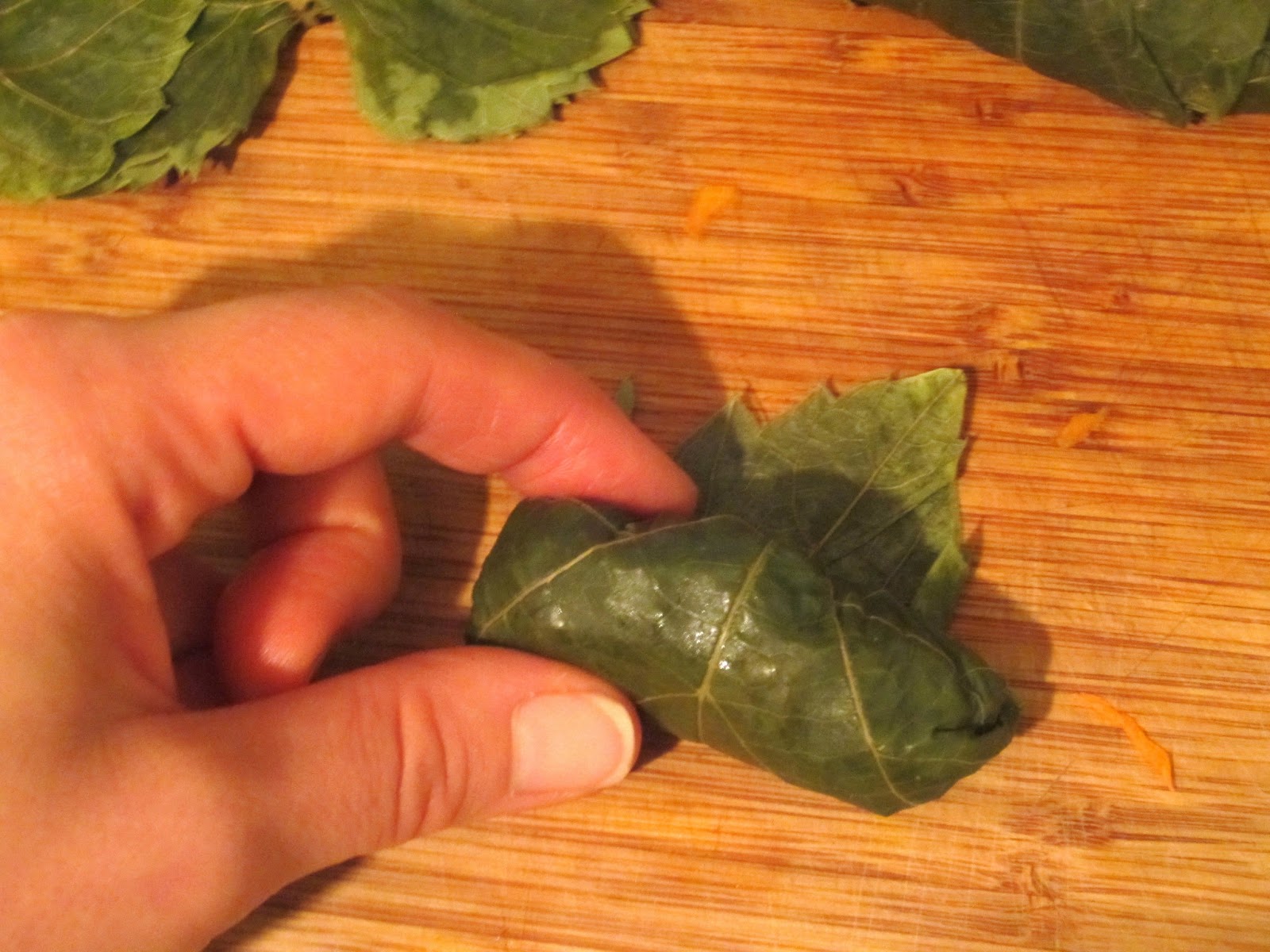
I stuff my grape leaves by carefully separating a thawed leaf, taking a dollop of filling and placing it in the middle of the leaf.  Then I fold the base up and over.
Then the sides are wrapped up.
Everything gets tucked in and rolled up, with the pointy tip of the leaf sealing everything into a nice little package!
I then briefly steam my stuffed grape leaves and serve 'em  up!
I'm so glad I put in those few hours last spring, harvesting, cleaning and freezing grape leaves, and I will definitely savour my supply and eagerly look forward to this year's harvest.

Wednesday, January 9, 2013

Evergreens Forever

Happy New Year to all!  I love this time of year.  Deep winter is when I get to slow down, read more, craft more and enjoy being a total homebody.  It's the season for endless pots of tea, naps, novels and seed catalogues.  It's also a nice time for walking in the forest to do a little winter wildcrafting. 

The ADG and I bused out to the south end of the city on the weekend to stroll through the Pine Grove. Not surprisingly, there are a lot of pine trees here, as well as other evergreens.  I like harvesting evergreens in the winter, when there's not much else going on, although you can gather any time during the year, especially in the spring, when there is fresh new growth.  Spring is the best time for young spruce tips.
Pictured here clockwise from top left is red pine, Scots pine, a spruce (not sure which one yet, maybe white?), and white cedar. 

Most conifers have edible and medicinal uses.  (The yew tree, which some botanists don't consider a true conifer, because it does not produce a seed-bearing cone, is poisonous.)  The conifers are rich in vitamin C and antioxidant flavonoids.  Early explorers to North America suffering and dying of scurvy were cured when the Native Americans taught them how to make tea from the needles of evergreens.  I love infusing pine and spruce needles into apple cider vinegar to extract all the vitamins and minerals.  Use it wherever you would use balsamic vinegar.

Rich in essential oils and terpenes, such as pinene and limonene, evergreens tend to have an antiseptic, decongestant and expectorant effect in the upper respiratory tract, making them a wonderful treatment for coughs, colds and sore throats.  A steam inhalation is a lovely way to get your evergreen medicine.  Infusing the needles in oil or rubbing alcohol makes for soothing, external rubs and liniments for achy bones, sore muscles and arthritic joints.

This winter I made a salve with balsam fir, spruce needle, and spruce pitch infused oils.  I slather it over my wet skin, fresh out of the shower, and I feel like I'm wearing a forest; a silky, smooth forest.

Even walking among these trees on a warm summer's day can have beneficial health effects.  According to Diana Beresford-Kroeger, pines release aerosols into the air, that, when inhaled, have a mild narcotic and anesthetic effect on the body.  Cedars release fenchone and thujone which stimulate the cardio-vascular system, and camphor and camphene, which act as bronchodilators to improve breathing.

Internally, the harsh resins in the conifers can begin to irritate the kidneys, if taken in large amounts for prolonged periods and internal used should be avoided altogether during pregnancy.

Of course, so many of the evergreens are considered sacred by the aboriginal peoples of North America, and are used for ceremonial purposes and various rituals.  Burning fir wood was used to give protection and to help people overcome fear of thunder and lightening.  Spruce roots were used to make ceremonial headgear and masks.  White pine was used a ghost medicine by the Seneca people who would make an eye wash for someone who had seen a dead person.  

It's too bad there's no such thing as scratch 'n sniff screen technology, 'cause I'd love for you to be able to bury your nose in this pile of cedar branches and breath deep!  Instead I guess you'll just have to go out and find your closest cedar hedge and stick your head in it.  You might look a little weird, but trust me, it'll be worth it!

Monday, December 24, 2012

Homemade for the Holidays

This little elf has been tinkering away in her workshop for weeks, crafting lots of holiday gifties.
With a large garlic harvest this year, I dehydrated quite a bit and put it through the spice grinder to make garlic powder.
When a friend told me he was making beef jerky for gifts, I was all like, "Whoa, that's a brilliant idea!"  So I made some too.
Pretty much everyone on my list is getting one of these little soap sacks.  It's for when your bars of soap get too small and fussy to use.  You put all those little slivers into the sack and use them up!
I had a panic attack when I realised I spelled coffee 'liquor' and not 'liqueur' and pretty much decided that Christmas was ruined because of it.  Then, while watching TV at my mom's the other night, a commercial for Kahlua come on with the tagline: "Kahlua, the original coffee liquor." Ha!  So Christmas is not ruined after all, but I'm pretty sure the commercial got it wrong too.
I loved making these herbal salves.  I lined up all my infused oils, picked some wonderful smelling combinations, melted the beeswax and spent a few hours concocting various salves and balms.
Aside from one brief and focused trip to a mall, and another to a specialty, local shop, I managed to avoid all shopping chaos, and instead, really enjoyed making these quick and easy, stress free gifts for my loved ones.

Wishing you and yours a wonderful, happy and safe holiday season!  May it be merry and bright!

Tuesday, December 11, 2012

Of Roots and Divinity

We had mild temperatures in Ottawa last week and I made use of that little weather window by harvesting these wild carrot (left) and evening primrose (right) roots.

The more I get to know these two plants, the more I love them.  Considered a weedy annoyance to many, I actually encourage these plants when they grace my garden with their presence.  In fact, this year I prepared and planted a bed of wild carrot from seeds that I gathered and saved from a previous season.

The roots have an intense carroty aroma and flavour.  The cultivated carrot that we all know and love is just a domesticated version of wild carrot. They even share the same Latin name: Daucus carota.  Wild carrot, or Queen Anne's Lace, as it is also known, has many edible and medicinal uses from seed to root.  A word of caution though: it is extremely important to have a 100% positive ID with this plant.  Two of the most deadly plants in North America, poison hemlock and water hemlock, are in the same family, and have been confused with wild carrot with fatal consequences.  A mistake you certainly don't want to make, so be sure to familiarise yourself with this plant and its poisonous look alikes, if you want to harvest it.
Evening primrose (Oenothera biennis) is another plant with many edible and medicinal parts.  I love the sweet, slightly mucilaginous flowers in salads and tincture them for medicinal use.  I dry the leaves for tea, gather the seeds and eat them for the nourishing oil they contain.  The roots have a sweet flavour with often a sharp, peppery or slightly acrid aftertaste.  I suspect this varies depending on growing conditions and times of harvest.  This batch was very sweet with no sharpness at all.
Some of these roots went into a delicious beef stew along with some garden carrots and parsnips, and the rest I dehydrated to add to my pantry.

I've got a handful of years foraging under my belt now, a growing body of knowledge and a good sense of the effort and discipline involved in the practice.  I've been eaten alive by mosquitoes, burned by midday sun,  covered in mud, soaked by rain, with wet feet squelching in my boots, while scrabbling in cold earth with freezing hands. 

I know gathering is the easy part and have spent long hours cleaning dirt out of gnarly roots, garbling leaves and carefully preserving the plants so nothing goes to waste.  And still, the romance has yet to wear off.  I get such a thrill learning about and working with wild plants.  I feel deeply grateful to be in relationship with nature in this way and fiercely protective of the spaces where plants grow.  I pray that I do right by the ecosystems that I interact with and ask for the wisdom to be a beneficial advocate on behalf of the plants.

You can't tell just by looking at the pictures above, but those unassuming roots are sacred to me.  Digging them out of the earth on dirty knees, an act of worship.  Spreading their seeds a prayer and gesture of hope for future abundance.

I've visited some of the most famous temples and sacred sites in the world and attended hundreds of church services over the years.  Some have left me inspired and soaring, others dull and sleepy.  My desire to experience the divine led to study religion in university.  In all my seeking, nothing has brought me closer to understanding the interconnectedness of all things as the wild plants have, and I am humbled by that.

Well, I did not start off this post thinking this is where I'd end up!  And I guess it might seem strange or downright blasphemous for some, to find religious ecstasy in a pile of weedy roots but there you have it.  Some people look at the natural world and see dollar signs, some see the possibility to know the divine in all its manifestations.  No doubt there is vast spectrum in between.  When you pass your favourite plant, I wonder what you see?

Saturday, December 8, 2012

Juliette of the Herbs

Watch this and fall in love!

Juliette of the Herbs from B Bee on Vimeo.

"Juliette of the Herbs is a beautifully filmed lyrical portrait of the life and work of Juliette de Bairacli Levy: world renowned herbalist, author, breeder of Afghan hounds, friend of the Gypsies, traveller in search of herbal wisdom and the pioneer of holistic veterinary medicine.
For more than 60 years Juliette lived with the Gypsies, nomads and peasants of the world, learning the healing arts from these peoples who live close to nature. Juliette's well-loved and now classic herbals for animals and for children have been a vital inspiration for the present day herbal renaissance and holistic animal care community. Juliette's extraordinary life story is as colourful and as exciting as her tremendous wealth of herbal knowledge.
Filmed on location with Juliette, 11 years before her death, and her Afghan hound in Greece, Spain, France, Portugal, Switzerland, England and America, and interwoven with Juliette's vast collection of archival photographs, together with scenes of Gypsies dancing and Bedouins with their herds, Juliette of the Herbs is an inspiring portrait of a remarkable healer."